Tucked along the Gulf of Guinea in West Africa, Togo is a land of vibrant culture, lush green landscapes, and time-honored artisanal traditions. While many travelers head to Lomé for its Atlantic coastline and vibrant artisan markets, venturing northward into the heart of the country reveals one of the continent’s most treasured heritage crafts: traditional shea butter production.
The Sacred Karité Tree: Heart of the Savanna
The journey of shea butter begins with the wild Karité tree (Vitellaria paradoxa). These resilient trees thrive across the sun-drenched savannas of central and northern Togo, especially in regions like Centrale, Kara, and Savanes. Unlike industrial monocultures, Karité trees are wild and non-domesticated:- Slow Growth: They take between 15 and 20 years to produce their first harvest of fruit.
- Longevity: A single tree can live and bear fruit for more than 200 to 300 years.
- Cultural Protection: Under Togolese customary law, cutting down a living shea tree is strictly prohibited. This community-enforced conservation safeguards local ecosystems and prevents deforestation across the Sahelian transition zone.
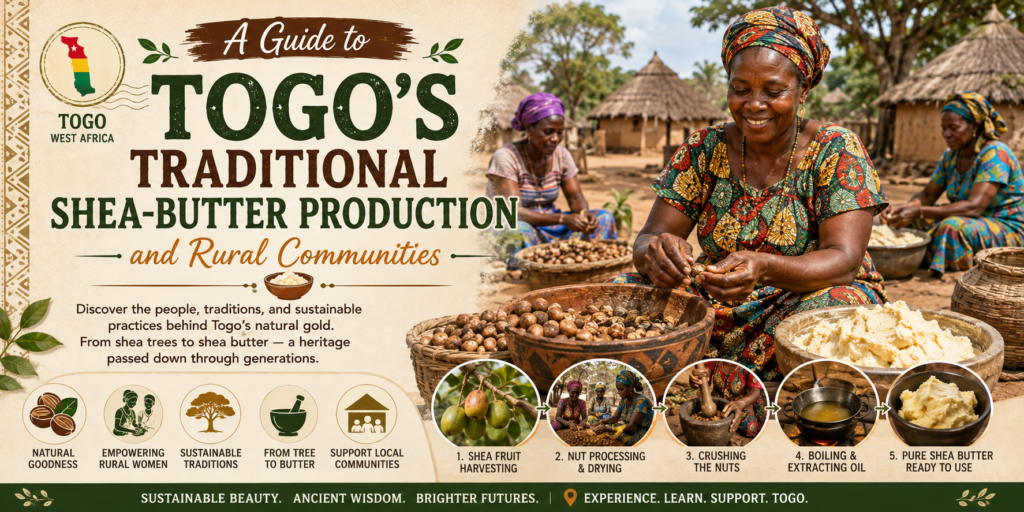
Step-by-Step: The Artisanal Art of Handcrafted Shea Butter
While modern industrial factories rely on chemical solvents like hexane to extract shea fat quickly, rural cooperatives in Togo continue to use a pure, handcrafted extraction method. This traditional technique retains the butter’s natural vitamins ($A$, $E$, and $F$), antioxidants, and rich moisturizing fatty acids.1. Harvesting and De-Pulping
Local women collect the fallen fruits early in the morning. The sweet, edible outer pulp is eaten or removed, uncovering the hard brown shell protecting the oil-rich kernel inside.2. Boiling and Sun-Drying
The nuts are briefly boiled in large metal pots to stop germination and preserve freshness. Afterward, they are spread across clean mats under the intense West African sun to dry for several days until their moisture content drops.3. Cracking and Sorting
Using small stones or wooden mallets, the women carefully crack open the shells by hand to release the glossy kernels. These kernels are then sorted by quality to ensure the purest final product.4. Roasting and Crushing
The kernels are gently roasted in wide clay ovens over wood fires, giving the raw butter its signature mild, nutty aroma. Once cooled, the roasted kernels are transferred to large wooden mortars and pounded into coarse granules.5. Grinding and Water-Kneading
The crushed kernels are ground into a smooth paste using traditional millstones. Next comes the most physically demanding step: hand-kneading. The paste is placed in large basins with clean water and whipped rhythmically by hand for hours. This delicate agitation forces the natural vegetable fats to separate and float to the surface as a light, creamy froth.6. Clarification and Solidification
The skimmed fat is gently simmered to evaporate any leftover water and settle natural sediments. The pure, golden liquid oil is filtered through fine cotton cloth and left to cool overnight, solidifying into silky, ivory-colored unrefined shea butter.Economic Empowerment and Women’s Cooperatives
In Togo, the shea value chain is almost entirely led by women. Village-level cooperatives give rural women financial independence, allowing them to:- Fund children’s primary and secondary school education.
- Invest in local healthcare and family wellness.
- Gain leadership roles and economic autonomy within their villages.
Planning Your Cultural Journey to Togo
Experiencing the shea harvest and visiting rural cooperatives offers an unforgettable look into the heart of West Africa. Before setting out on your trip, make sure your travel logistics and entry documents are in place. International travelers can conveniently check their visa eligibility and apply for Togo e-visa online well before their departure date to ensure a smooth arrival.Highlights to Include in Your Itinerary:
- The Markets of Kara: Explore regional trading posts where women sell raw, fragrant shea balls wrapped in fresh banana leaves.
- Cooperative Workshops in Sokodé: Take part in guided demonstrations and learn the intricate rhythm of traditional butter churning.
- Lomé’s Grand Marché: Shop for bespoke, shea-infused artisanal soaps, balms, and natural cosmetics created by local entrepreneurs.
Why Choose Us for Your Togo Travel Visa?
Preparing for an international trip should be exciting, not stressful. We help you secure your travel documents with speed, security, and precision.- Reliable Travel Visa Services: Our streamlined global approach has assisted countless travelers in successfully obtaining their visas.
- Round-the-Clock Assistance: Reach out to our dedicated support team 24/7 for prompt answers to your questions.
- Experienced Visa Consultants: Get professional guidance to ensure your application meets every government requirement.
- Efficient Visa Application Process: Complete your submission in just minutes with our user-friendly digital platform.