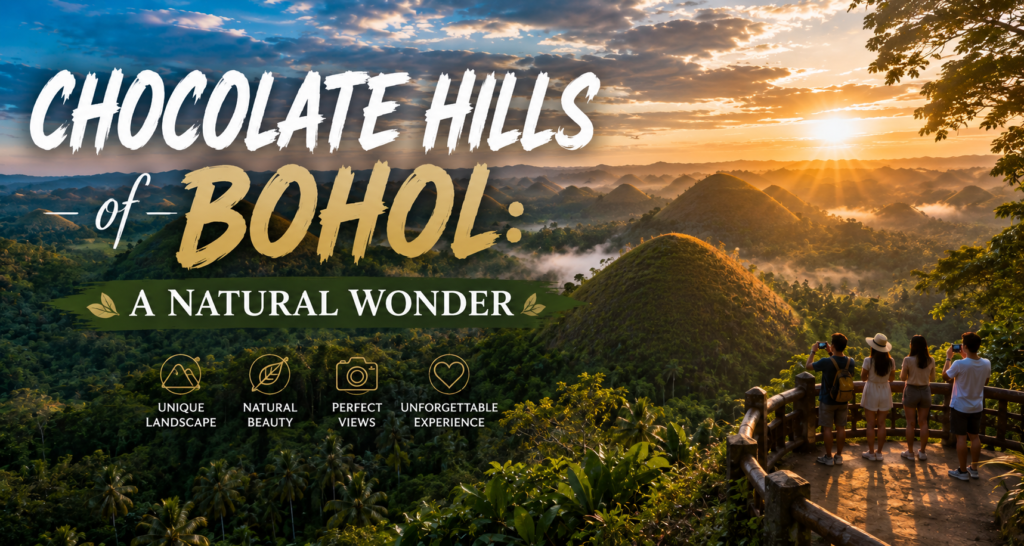
Have you ever looked at a landscape and wondered if you had stepped right into a fantasy novel? That is exactly how it feels to stand in front of the Chocolate Hills in Bohol, Philippines.
This breathtaking geological formation looks so perfectly symmetrical that it is hard to believe human hands—or heavy machinery—didn’t shape them. Whether you are an adventure seeker, a nature lover, or a curious traveler, this guide covers everything you need to know about this world-famous landmark.
Let’s dive into the most frequently asked questions about the spectacular Chocolate Hills of Bohol.
1. What exactly are the Chocolate Hills of Bohol?
The Chocolate Hills are an extraordinary geological formation consisting of a vast, rolling terrain of conical, dome-shaped hills. Unlike typical mountain ranges that feature jagged peaks and long ridges, these hills are almost perfectly symmetrical.
They are covered in lush green grass most of the year. However, during the dry months, the grass completely dries up and turns a deep, cocoa-brown color. From a distance, they look exactly like giant Hershey’s Kisses dropped across the landscape, which is how they got their famous name.
2. Where are the Chocolate Hills located in the Philippines?
This natural wonder is located in the island province of Bohol, which sits in the Central Visayas region of the Philippines.
While the hills spread across an area of more than 50 square kilometers (about 20 square miles), they are primarily concentrated within three major inland municipalities:
Carmen (home to the main viewing deck and tourist complex)
Sagbayan (home to the Sagbayan Peak viewing area)
Batuan
Most travelers stay in the beach-heavy area of Panglao Island or the capital city of Tagbilaran and make a day trip inland to see the hills.
3. How many Chocolate Hills are there in Bohol?
The exact number of hills is a bit of a local debate, but official estimates put the count between 1,260 and 1,776 individual hills.
Because they are scattered over such a massive area, you can never see all of them at once. However, standing on the high viewing platforms gives you a panoramic view of hundreds of these dome-like mounds stretching all the way to the horizon.
4. How were the Chocolate Hills formed?
If you ask a geologist, they will tell you that the Chocolate Hills are a classic example of karst topography.
Millions of years ago, this entire region was underwater, sitting at the bottom of a prehistoric ocean. Over vast stretches of time, marine limestone—made from layers of ancient coral reefs, shells, and marine fossils—accumulated on the seabed.
Tectonic forces eventually pushed this limestone plateau up above sea level. Once exposed, rainwater, streams, and groundwater slowly eroded the soft, fractured limestone over thousands of years, leaving behind the hard, symmetrical cone shapes we see today.
5. What are the legends behind the Chocolate Hills?
While science has its explanation, local Filipino folklore offers much more colorful tales!
The Fighting Giants: The most popular legend tells of two colossal giants who got into a fierce argument. They threw massive chunks of sand, rocks, and mud at each other for days until they were completely exhausted. Exhausted and forgotten, they made peace and left the island, leaving the giant piles of earth behind.
The Giant’s Tears: Another heartbreaking story tells of a young, powerful giant named Arogo who fell in love with a mortal woman named Aloya. When Aloya tragically fell ill and died, Arogo wept bitterly. His giant tears fell to the earth, dried up, and solidified to become the hills.
The Greedy Carabao: A funnier local tale says a giant water buffalo (carabao) was eating all the villagers’ crops. To teach it a lesson, the villagers left out spoiled food. The buffalo got a massive stomach ache, and its dried droppings left across the fields became the hills!
6. Why are they called the “Chocolate” Hills?
They aren’t actually made of chocolate, but they certainly look like it!
During the peak of the dry season, the tropical heat dries out the grass blanket covering the limestone mounds. The green vegetation turns a rich, toasted brown. Against the bright blue sky, the hills look like a giant tray of chocolate pralines or cocoa truffles.
7. Are the Chocolate Hills always brown?
No! This is a common misconception that surprises many first-time visitors.
For the majority of the year, during the rainy and intermediate seasons, the hills are actually covered in a vibrant, velvety green grass. During these months, they look like “mint chocolate” hills. They only transform into their signature chocolate-brown color during the driest months of the year.
8. When is the best time to visit the Chocolate Hills?
If you want to see the hills in their iconic brown chocolate state, the best time to visit is during the dry season, from December to May. The peak dry months of March, April, and May offer the highest chance of seeing the dried, cocoa-colored hills.
If you prefer a lush, green, tropical landscape, then visiting between June and November (the wet season) is ideal.
No matter the month, the best times of day to visit the viewing decks are early morning (for sunrise and misty landscapes) or late afternoon (to catch a stunning golden hour sunset).
9. How do you get to the Chocolate Hills?
Bohol is highly accessible from major travel hubs in the Philippines.
Fly In: You can book a flight directly to Bohol-Panglao International Airport (TAG).
Take a Ferry: If you are staying in nearby Cebu City, you can take a fast ferry (like OceanJet) to the Tagbilaran Port, which takes about two hours.
Local Land Travel: From Tagbilaran or Panglao, you can reach the Chocolate Hills in about 1.5 to 2 hours. You can rent a motorbike, hire a private car with a driver, or take a public bus from the Dao Bus Terminal in Tagbilaran heading towards Carmen.
10. How many steps do you have to climb at the viewing deck?
At the main Chocolate Hills Complex in Carmen, you cannot climb on the hills themselves to protect their fragile ecosystem. Instead, you climb up a designated hill that serves as the main observation deck.
To reach the top platform, you must walk up 214 stone steps. Fun Fact: The staircase was specifically designed with 214 steps to represent Valentine’s Day (February 14, or 2/14) as a nod to the romantic legend of the giant’s tears! There are resting spots along the way if you need to catch your breath.
11. What activities can you do at the Chocolate Hills?
While viewing the hills from the observation deck is the classic experience, there is plenty of adventure waiting at the base:
ATV and Buggy Rentals: You can rent an All-Terrain Vehicle (ATV) and guide yourself along muddy, rugged trails weaving right between the foothills.
Chocolate Hills Adventure Park (CHAP): Located nearby, this eco-adventure park offers a thrill-seeking “Bike Zipline” where you ride a bicycle on a cable suspended high above the ground with panoramic views of the hills.
Spot the Tarsiers: Most day tours combine a visit to the hills with a stop at the nearby Philippine Tarsier Sanctuary in Corella to see one of the world’s smallest primates.
12. Do you need a visa to travel to the Philippines and see the Chocolate Hills?
Depending on your nationality, you may need a travel authorization to enter the country. While many nations enjoy short visa-free entry, securing your official Philippines Visa application early is the best way to avoid stressful terminal delays and ensure your entry is guaranteed.
If you want a completely stress-free experience getting your travel documents sorted, we are here to help.
Why Choose Us for Your Philippines Visa?
Reliable Travel Visa Services: Our global approach has assisted numerous travelers in obtaining their visa, ensuring peace of mind before they even pack their bags.
Round-the-Clock Assistance: Reach out to us 24/7, and our dedicated team of experts will respond within 72 hours to solve any queries you have.
Experienced Visa Consultants: Receive expert guidance and thorough checks to maximize the acceptance rate of your application.
Efficient Visa Application Process: Skip long embassy lines and confusing paperwork by using our streamlined online Philippines visa application to apply in minutes.
Ready to see the iconic Chocolate Hills in person? Secure your Philippines travel visa today and start planning your ultimate tropical getaway!